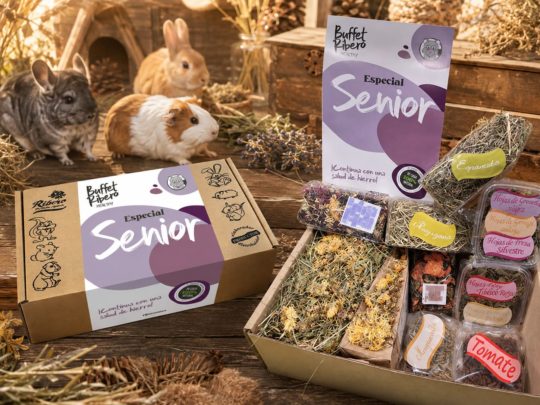
Healthy SENIOR Buffet for Rabbits and Rodents
Keep going strong and healthy!
The Ribero Healthy Senior Buffet for rabbits and rodents brings together hay, forage, plants, leaves, vegetables and selected pellets to provide fibre, plant variety and different aromas and textures during a stage of life when an animal’s needs may begin to change.
As the years go by, changes can occur in weight, mobility, muscle condition, appetite or the way an animal eats. For this reason, a good diet for senior rabbits and rodents should always be adapted to the species, age, body condition and individual health status of each animal.
Good-quality hay remains essential. In addition, maintaining an active routine, scheduling regular veterinary check-ups and paying attention to small changes in behaviour become even more important.
Healthy Senior brings together different Ribero products so that older animals can continue enjoying food through new aromas, flavours, textures and small exploration experiences.
When can we consider our little companion to be senior?
There is no exact age that marks the beginning of the senior stage for every animal.
In rabbits, for example, ageing depends on factors such as breed, size, genetics, lifestyle and health status. Some may begin to show age-related changes at around 5–6 years old, while others remain in excellent condition for much longer.
For this reason, rather than focusing only on a number, we should look at each animal individually.
Changes in activity levels, weight, mobility, appetite, coat condition or daily habits may indicate that it is time to adapt certain aspects of their care.
Diet during the senior stage
An appropriate diet for senior rabbits and rodents should continue to be based on hay and fibre.
Rabbits need good-quality hay available ad libitum, as it encourages prolonged chewing and provides the fibre required for normal digestive function.
However, getting older does not mean that every animal should automatically eat less.
Some animals may be prone to gaining weight if their activity decreases, while others may lose weight or muscle mass. The diet should therefore be adapted to their actual body condition rather than their age alone.
Clean, fresh water should also always be available.
Hay remains the star of the diet
A senior diet does not mean replacing hay with softer foods.
As long as the animal is able to chew normally, hay should continue to play a fundamental role in the diet.
Grass hays provide fibre and require prolonged chewing. Offering different types of forage can also help maintain interest in food and encourage natural selection and foraging behaviours.
That is why Healthy Senior combines different forages and complementary foods to provide variety without replacing the essential role of hay.
What does the Healthy Senior Buffet for rabbits and rodents contain?
Fescue Hay and Oat Hay
Healthy Senior combines fescue hay and oat hay.
Both are grass hays that provide fibre and offer different structures, aromas and textures.
Fescue encourages prolonged chewing thanks to the structure of its fibres. Oat hay, meanwhile, introduces another shape, texture and aroma into the usual diet.
This allows us to increase forage variety while keeping hay as the basis of the diet.
Relaxing COAD
The Relaxing COAD is a blend of hay, plants and leaves selected to provide plant variety as part of a complementary diet.
Its combination of ingredients introduces different aromas, flavours and textures and can be mixed with the usual hay.
It can also be used in small food-searching activities.
Discover the Ribero COAD Range too, with different blends designed to accompany different stages and nutritional needs.
Leaf Selection
Healthy Senior includes a combination of elder leaves, flowers and berries, red clover leaves and flowers, strawberry leaves, ginkgo biloba leaves and blackcurrant leaves.
The combination of different leaves provides variety in size, shape, aroma and texture.
They can therefore be offered in small amounts as a complement, mixed with hay or used in foraging activities.
Discover our LEAVIX Range too, with different leaves and selected blends for rabbits and small rodents.
Sainfoin
Sainfoin is a traditional forage legume with a different texture and aroma from grass hays.
It can be offered in appropriate amounts as a complement to broaden the variety of forage available.
It can also be mixed with hay to encourage selection and exploration.
Ryegrass
Ryegrass is a long-leaved forage that provides another structure and texture during chewing.
Combining different types of forage helps maintain dietary variety and may help keep the animal interested in food.
Pellets: TOMATO AND CAMOMILE
Healthy Senior is made with tomato pellets and camomile pellets, made using a steam pelletisation process.
Their small size means they can be offered individually, hidden among the hay or placed inside toys and dispensers.
In this way, they can also be used to create small activities adapted to each animal’s mobility level.
Dehydrated Vegetables
The buffet contains a combination of carrot, cucumber and tomato.
Dehydrated vegetables provide different flavours, aromas and textures and help increase variety within the complementary diet.
As they are dehydrated products, they should be offered in moderate amounts and do not replace fresh vegetables suitable for each species.
Maintaining an appropriate weight during the senior stage
Weight is one of the aspects that should be monitored particularly closely as an animal gets older.
Some senior animals reduce their activity levels and may gain weight. Others, however, may begin to lose weight due to dental problems, illness, metabolic changes or reduced food intake.
The aim should therefore not simply be to provide a “low-calorie” diet, but to maintain an appropriate body condition.
Regularly weighing the animal can help detect changes that might otherwise go unnoticed.
If you notice significant weight loss or weight gain, consult a veterinarian specialised in exotic animals.
Should fruit be removed from the diet as they get older?
Not necessarily.
Fruit is more concentrated in sugars and should therefore only be offered to rabbits as an occasional treat and in small quantities, whether they are young or senior.
For a senior animal with excess weight, diabetes, digestive problems or other conditions, a veterinarian may recommend limiting it further or removing it altogether.
However, we should not assume that all older animals have exactly the same nutritional needs.
The diet should therefore always be adapted to each animal.
Movement and adapting the environment
Getting older does not mean stopping moving.
Physical activity remains important, although the environment and activities may need some small adaptations.
For example, we can make access to hay and water easier, avoid slippery surfaces, reduce excessively high jumps and distribute several feeding points to encourage gentle movement.
Food itself can also be used to encourage exploration.
This allows us to maintain an active routine without requiring uncomfortable or excessive movements.
Veterinary check-ups during the senior stage
As an animal gets older, regular veterinary check-ups become even more important.
Rabbits can hide signs of illness, so seemingly minor changes in appetite, weight, mobility or behaviour deserve attention. Regular examinations allow the veterinarian to assess the teeth, weight, eyes, skin, mobility and other parameters and decide whether any additional tests are needed.
Some conditions, such as chronic kidney problems, may also become more common in older animals.
The frequency of veterinary check-ups should be determined by the veterinarian according to the animal’s age and individual health status.
Enrichment adapted to their pace
The Healthy Senior Buffet for rabbits and rodents can also be used to create enrichment activities adapted to older animals.
For example:
- hide leaves among small amounts of hay;
- distribute different types of forage across several accessible areas;
- prepare a simple foraging tray;
- place some pellets inside easy-to-use toys;
- combine different aromas and textures;
- create short food-searching routes adapted to their mobility.
In this way, we continue to stimulate curiosity, smell, exploration and foraging behaviour.
«Because getting older does not mean stopping discovering, exploring and enjoying life.»
When should we see a veterinarian?
Consult a veterinarian specialised in exotic animals if you notice:
- significant weight loss or weight gain;
- reduced appetite;
- difficulty chewing or unusual food selection;
- changes in droppings;
- increased water intake or changes in urine;
- difficulty walking, jumping or getting up;
- sores developing on weight-bearing areas;
- loss of balance;
- lethargy;
- significant changes in normal behaviour.
In a senior animal, a change that may appear to be simply due to “old age” can have an underlying medical cause that should be assessed.
IMPORTANT
Healthy Senior is a complementary food.
It does not prevent, diagnose or treat diseases associated with ageing and does not replace a complete and balanced diet, good-quality hay available ad libitum, appropriate physical activity or care from a veterinarian specialised in exotic animals.
The nutritional needs of a senior animal may vary considerably depending on its species, age, weight, activity level, dental health and clinical condition.
For animals with kidney, digestive, dental or joint conditions, excess weight, weight loss or those undergoing any treatment, consult your VETERINARIAN SPECIALISED IN EXOTIC ANIMALS beforehand.
 English
  Spanish