
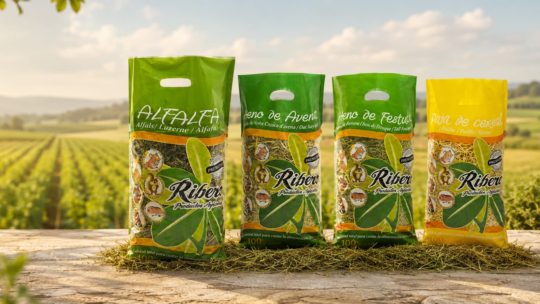

Basic Hay for Rabbits and Rodents
Hay is an essential part of the daily diet of rabbits, guinea pigs and chinchillas. Its naturally high fibre content supports healthy digestive function and encourages prolonged chewing, which helps promote natural dental wear.
At Ribero, we grow, harvest, sun-dry, select and package our own forage. We control the entire process to guarantee full product traceability and preserve its natural aroma, colour, texture and flavour as much as possible.
Discover our range of fescue hay, oat hay and alfalfa hay, as well as our barley straw. Each variety has different characteristics and helps add variety to the diet and environment of rabbits and other small animals.
Why choose Ribero hay?
Our hay and forage are produced through a carefully controlled process, from the field to the final packaging:
- Cultivation and selection of raw materials.
- Harvesting at the optimal time.
- Natural sun-drying.
- Long-stem, uncompressed presentation.
- Packaging designed to preserve texture and reduce breakage.
- Full traceability throughout the production process.
The result is a natural, aromatic product with varied textures, specially prepared to encourage the daily consumption of hay.
BASIC HAY
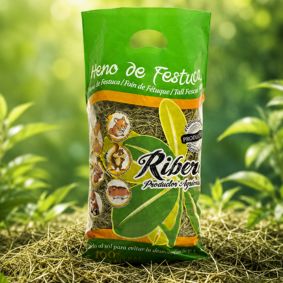
Fescue Hay
Fescue hay is an essential part of the daily diet of rabbits, guinea pigs and chinchillas thanks to its naturally high fibre content. It should be available every day in unlimited quantities. It can also be offered as a complementary food for hamsters, squirrels and other small rodents.
Fescue is one of the most suitable types of hay for daily feeding because:
- It is an essential part of a balanced diet.
- It supports natural and continuous dental wear.
- Its high insoluble fibre content helps support normal intestinal function.
- It contributes to healthy digestion and regular intestinal transit.
- It provides natural compounds with antioxidant properties.
- It helps support the body’s natural defences.
- It encourages prolonged chewing and natural feeding behaviour.
Directions for use
Provide fescue hay freely every day as the main complementary food. Place it in a hay rack or feeder to keep it clean, dry and fresh.
The animal must always have access to clean, fresh water.
An additional amount of hay can also be placed in its resting area to provide extra comfort, encourage natural behaviours and help it stay warm.
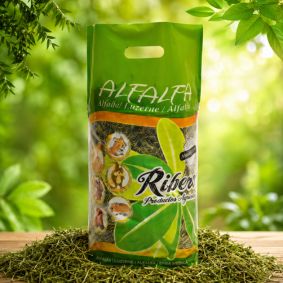
Alfalfa Hay
Alfalfa hay is naturally rich in fibre, protein and calcium. It is particularly suitable for rabbits, guinea pigs and chinchillas during growth, pregnancy, nursing or recovery, when their nutritional needs may be higher.
For healthy adult animals, it can be offered in small amounts as an occasional complement, combined with their usual hay. It can also be given as a complementary food to hamsters, squirrels and other small rodents.
Alfalfa stands out for its nutritional composition because it:
- Supports the normal growth and maintenance of bones and teeth.
- Provides vitamin K, which is involved in the normal blood-clotting process.
- Supplies nutrients required for the normal functioning of the body.
- Contains natural compounds with antioxidant properties.
- Provides fibre, protein, minerals and vitamins.
- Adds variety of aromas, flavours and textures to the diet.
Natural nutritional composition
Alfalfa contains a wide variety of nutrients, including:
- Plant-based proteins.
- Dietary fibre.
- Calcium.
- Phosphorus.
- Minerals.
- Vitamins A, B1, B12, C, D, E and K.
Due to its naturally high protein and calcium content, the amount offered should be adapted to each animal’s age, physiological condition and individual nutritional needs.
Directions for use
For adult rabbits, guinea pigs and chinchillas, offer in small amounts as a complement to Ribero hay provided daily as their main forage. It can be given occasionally to add variety to the diet, in the same way as certain fruits and vegetables.
During growth, pregnancy, nursing or recovery, it may be offered daily in small amounts, always alongside a hay suitable for regular consumption.
Place it in a hay rack or feeder to keep it clean, dry and fresh. The animal should always have access to clean, fresh water.
For adult animals with special nutritional needs, a history of urinary problems or calcium-controlled diets, it is advisable to consult an exotic-animal veterinarian to determine the appropriate amount.
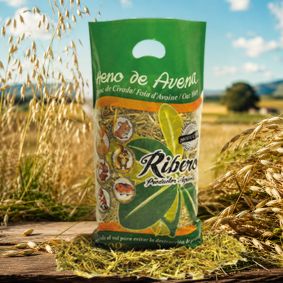
Oat Hay
Oat hay is a fibre-rich complementary hay suitable for rabbits, guinea pigs, chinchillas, hamsters, squirrels and other small rodents.
Unlike fescue hay, it should not be considered the staple hay in the diet, as it does not provide the nutritional balance required when offered as the sole daily forage. It should be combined with fescue hay, which is the main hay in the regular diet of rabbits, guinea pigs and chinchillas.
Oat hay adds variety, energy and nutrients that support coat maintenance, making it especially suitable during moulting periods.
Its main characteristics include:
- Helps support natural and continuous dental wear.
- Its high insoluble fibre content supports normal intestinal function.
- Contributes to healthy digestion and regular intestinal transit.
- Provides energy and nutrients that support coat maintenance.
- Helps make periods of heavy moulting easier to manage.
- Adds variety of aromas, flavours and textures to the diet.
- Encourages better acceptance and consumption of daily hay.
- Can be mixed with fescue hay to enrich the diet without replacing the staple hay.
Rainfed oat hay
Unlike other types of hay grown using irrigation, Ribero oat hay comes from rainfed fields, and its growth depends directly on the rainfall received during each growing season.
This cultivation method determines its natural appearance. It is not a fine, long-stemmed and completely green hay. Instead, it is characterised by:
- Broader leaves.
- Shorter stems and strands.
- A more yellowish colour, with greenish shades or highlights.
- A texture and structure typical of oats grown on rainfed land.
These characteristics do not mean that the hay is excessively dry, old or of lower quality. They are the natural result of a crop that depends entirely on the weather conditions and rainfall of each season.
For this reason, the colour, length and proportion of green tones may vary slightly from one harvest to another, while always retaining the characteristic qualities of the product.
Grown, harvested and packaged by Ribero
At Ribero, we grow, harvest, dry, store, select and package our own oat hay.
We control the entire process, from cultivation in our rainfed fields to final packaging, to guarantee full traceability and offer a natural, aromatic and high-quality product.
Every stage is carried out with the necessary care to preserve its texture, aroma, flavour and the distinctive characteristics of rainfed oat hay as much as possible.
Directions for use
Oat hay should be offered as a complement to fescue hay and not as the only hay for regular daily consumption.
During moulting periods, it can be offered daily mixed with fescue hay.
At other times of the year, it is recommended three to four times a week as a maintenance complement and to add variety to the diet.
Place it in a hay rack or feeder to keep it clean, dry and fresh. The animal should always have unlimited access to fescue hay and clean, fresh water.
To support periods of heavy moulting, combine oat hay with fescue hay every day. Outside the moulting season, offer it three or four times a week as a maintenance complement.
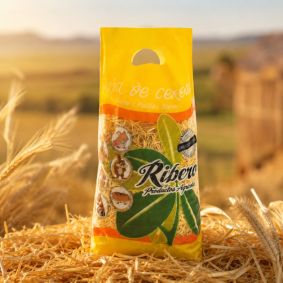
Barley Straw
Barley straw provides insoluble fibre, which supports normal intestinal function, promotes healthy digestion and helps maintain regular intestinal transit. It also contains natural compounds with antioxidant properties and contributes to the maintenance of the body’s natural defences.
Thanks to these characteristics, barley straw can help prevent digestive imbalances or episodes of loose stools, always as part of a balanced diet based primarily on fescue hay.
Barley straw stands out because:
- Its high fibre content supports normal intestinal function.
- It contributes to healthy digestion and regular intestinal transit.
- It can help prevent digestive imbalances and episodes of loose stools.
- It provides natural compounds with antioxidant properties.
- It helps support the body’s natural defences.
- It contributes to natural dental wear through chewing.
- It can be offered as a complement to fescue hay.
- It is also suitable for providing warmth, softness and comfort in the resting area.
Barley straw as a comfort material
Barley straw can be used to prepare the resting area and provide a warmer, more comfortable surface for the animal.
Its texture allows rabbits and other small animals to dig, explore, nibble and build sheltered areas, helping to encourage their natural behaviours.
During the colder months, a larger amount can be added to help retain warmth and create a more cosy environment.
Straw does not replace absorbent bedding when moisture or urine needs to be controlled. In these cases, it can be placed on top of the usual bedding as an additional comfort layer.
Directions for use as food
Offer in small quantities as a complement to fescue hay, not as the only forage for regular daily consumption.
When used as food, place it in a hay rack or feeder to keep it clean, dry and fresh.
The animal should always have unlimited access to fescue hay and clean, fresh water.
Directions for use as a comfort material
Spread the required amount in the resting area, over clean, absorbent bedding where appropriate.
Remove any damp or dirty sections and replace the straw regularly to keep the area clean, dry and comfortable.
 English
  Spanish