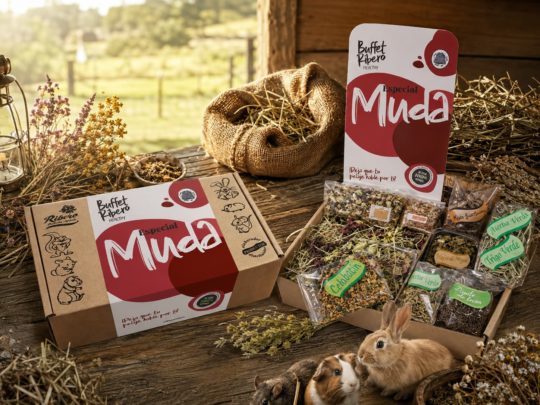
Healthy SPECIAL MOULTING Buffet for Rabbits and Rodents
Grow into your best version!
The Ribero Healthy Special Moulting Buffet for rabbits and rodents brings together hay, forage, plants, leaves, flowers, vegetables, roots and selected pellets to provide fibre, plant variety and different aromas and textures during moulting periods.
Coat renewal is part of the natural cycle of rabbits and other small animals. During these periods, they may ingest more hair while grooming, which is why daily brushing, a fibre-rich diet and proper hydration become especially important.
Moulting in rabbits: a natural process
Rabbits naturally renew their coat. Moulting tends to be particularly noticeable at certain times of the year, although its intensity and frequency can vary from one animal to another.
Rabbits living indoors may also show less seasonal moulting patterns due to the environmental conditions in our homes.
During moulting, it is common to find loose hair, tufts and areas where the transition between the old and new coat is clearly visible.
However, normal moulting should not be confused with hair loss caused by dermatological problems or other conditions.
Brushing, hay and water during moulting
Rabbits spend a great deal of time grooming themselves and, as they lick their coat, they ingest some of the loose hair.
For this reason, during moulting periods, it is especially advisable to remove loose hair regularly through brushing.
This helps reduce the amount of hair they may ingest while grooming.
At the same time, good-quality hay available ad libitum remains essential. Its fibre content contributes to normal digestive function, and hay should continue to form the basis of the diet.
We should also make sure that clean, fresh water is always available.
Además, debemos asegurarnos de que siempre tengan agua limpia y fresca disponible.
What does the Healthy Moulting Buffet for rabbits and rodents contain?
Fescue hay with oat hay
Healthy Special Moulting combines fescue hay and oat hay, two types of forage with different characteristics.
Fescue is a fibre-rich grass whose structure encourages prolonged chewing.
Oat hay, meanwhile, provides a different texture, aroma and plant structure, helping to increase forage variety during moulting. Its natural carbohydrate content also provides nutritional support during periods of coat renewal.
Combining different types of hay also helps maintain interest in food and turns the selection of different strands into a small exploration activity.
Special Moulting COAD
SPECIAL MOULTING COAD contains a blend of hay and selected plants designed to accompany coat renewal and provide fibre and plant variety during moulting.
Its hay base helps support normal digestive transit, an especially important aspect during moulting periods, when rabbits may ingest more hair while grooming.
Discover the Ribero COAD Range too, with different blends designed to accompany different stages and nutritional needs.
Walnut leaves
Healthy Special Moulting includes walnut leaves as part of its plant selection.
The dried leaves provide a different aroma, shape and texture and can be offered as a complement or mixed with hay.
This helps increase the sensory variety of the diet.
Discover our LEAVIX Range too, with different leaves and selected blends for rabbits and small rodents.
Green oats and green wheat
Green oats and green wheat are plant forages that add new structures and textures to the complementary diet.
They can be mixed with the usual hay, helping to increase variety and encouraging the animal to search for and select different strands.
You can discover these and other plants in our HERBIX Range.
Dehydrated courgette
Dehydrated courgette adds a different texture and flavour to the Healthy Special Moulting Buffet.
It can be offered in small amounts as a complementary food or used as part of foraging activities.
Burdock root
Burdock root provides a completely different consistency from hay, leaves and flowers.
Its format encourages the animal to hold it, manipulate it and gnaw it, introducing a new experience into complementary feeding.
It can also be used as an enrichment item.
Pellets: green oats and dandelion
The buffet is completed with green oat pellets and dandelion pellets, made using a steam pelletisation process.
Thanks to their small size, they can be offered as a complement, hidden among hay or placed inside toys and dispensers to encourage foraging.
Flower mix
The buffet contains a blend of arnica, hops and hibiscus.
The flowers provide different colours, aromas, shapes and textures within the selection.
They can therefore be mixed with hay or scattered in small amounts as part of food-searching activities.
What happens to the hair they ingest?
Finding some hair in the droppings during moulting can occur as a result of grooming.
However, we now know that hair should not automatically be considered the cause of gastrointestinal stasis. When intestinal transit slows down, gastrointestinal contents — including ingested hair — may accumulate.
For this reason, adequate hay intake, proper hydration, movement and frequent brushing are especially important during moulting.
It is also advisable to monitor appetite, droppings and behaviour every day.
A fibre-rich diet during moulting
During moulting, the usual diet should not be replaced by specific products.
Good-quality fescue hay should remain available ad libitum and continue to form the basis of the diet.
Healthy Special Moulting can complement this base with different forages, plants, leaves and other plant-based ingredients.
Any new food should also be introduced gradually and in amounts appropriate to each species.
A buffet to accompany a period of change
The Healthy Moulting Buffet for rabbits and rodents brings together different Ribero products in one selection to accompany this natural stage of coat renewal.
Fescue, oats, green forage, leaves, flowers, vegetables, roots and pellets provide different aromas, flavours and textures.
In this way, we can complement their diet while turning feeding time into an exploration experience.
«Because changing coats can also mean searching, discovering, exploring and enjoying.«
How should the Healthy Moulting Buffet be offered?
The contents of the buffet should be used as a complement to a balanced diet adapted to each species.
You can distribute the different ingredients over several days and combine them with the usual hay.
When introducing a new food, always do so gradually and in small amounts.
Also make sure that good-quality hay and clean, fresh water are always available.
Remember: it is also food enrichment
The Healthy Moulting Buffet for rabbits and rodents does not have to be served simply in a food bowl.
You can use its different components to encourage natural behaviours. For example:
- hide leaves and plants among the hay;
- scatter small pieces of courgette in different areas of their environment;
- prepare a foraging tray;
- hide some pellets inside toys or dispensers;
- offer burdock root as something to manipulate and gnaw;
- combine different types of hay and forage to encourage selection.
In this way, as well as providing variety, we encourage exploration and foraging behaviour.
When should we see a veterinarian?
During normal moulting, the amount of loose hair in the environment may increase, and some hair may also appear attached to droppings.
However, particular attention should be paid if you notice reduced appetite, smaller or fewer droppings, absence of droppings, pain, a distended abdomen, lethargy or significant behavioural changes.
These signs may be associated with a gastrointestinal problem and require veterinary assessment.
Likewise, if you notice completely bald areas, irritation, wounds, flaking, intense itching or hair loss that differs from normal moulting, consult a veterinarian specialised in exotic animals.
IMPORTANT
Healthy Special Moulting is a complementary food.
It does not prevent, diagnose or treat obstructions, gastrointestinal stasis, dermatological problems or any other disease.
It does not replace a complete and balanced diet, good-quality hay available ad libitum, appropriate brushing during moulting or care from a veterinarian specialised in exotic animals.
For animals with digestive or dermatological conditions, special requirements or those undergoing any treatment, consult your VETERINARIAN SPECIALISED IN EXOTIC ANIMALS beforehand.
 English
  Spanish