
Healthy Dental Wear Buffet for rabbits and rodents
Keep taking bites out of life!
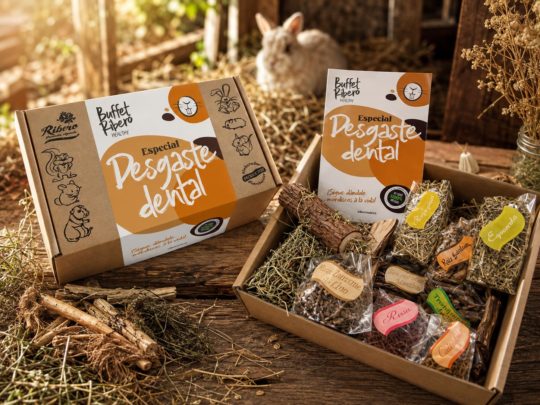
The Healthy Dental Wear Buffet for rabbits and rodents by Ribero brings together hay, forage, leaves, roots, small pieces of wood and other complementary foods selected to support chewing, gnawing and natural dental wear.
The teeth of rabbits, guinea pigs and chinchillas grow continuously throughout their lives. For this reason, a diet rich in high-quality hay, together with suitable materials to gnaw, plays a fundamental role in their natural chewing habits.
In addition, Healthy Dental Wear turns feeding into an enrichment activity. Different sizes, aromas and textures encourage the animal to search, select, chew, gnaw and explore.
Why is dental wear so important?
Rabbits, guinea pigs and chinchillas need to chew for long periods of time. Therefore, hay and other fibrous forage should play a central role in their diet.
The structure of hay fibres requires the animal to make repeated chewing movements. In this way, as well as providing fibre in the diet, hay supports the physiological wear of teeth that continue growing throughout life.
However, diet is not the only factor related to dental health. Genetics, trauma, occlusion problems, certain diseases and other conditions can affect the teeth and the structures around them.
For this reason, Healthy Dental Wear does not replace veterinary check-ups and cannot correct an existing malocclusion or dental problem.
Hay: the basis of prolonged chewing
A diet based mainly on high-quality hay available at all times encourages prolonged chewing and natural grinding movements.
In addition, offering different types and textures of forage can increase interest in food and encourage the animal to spend more time selecting and chewing.
The Healthy Dental Wear Buffet for rabbits and rodents combines foods with different structures to offer a varied chewing and gnawing experience.
What does the Healthy Dental Wear Buffet for rabbits and rodents contain?
Fescue Hay Tunnel
The Fescue Hay Tunnel combines feeding and enrichment in a single product.
Fescue is a fibre-rich grass whose structure encourages prolonged chewing. In addition, the tunnel format invites the animal to investigate, search for the hay inside and gnaw. In this way, feeding time also becomes an exploration activity.
Rose and Calendula Pellets
The buffet also includes rose pellets and calendula pellets, made using a steam pelletisation process.
Thanks to their small size, they can be offered as a complementary food, hidden among hay or placed inside toys and dispensers to encourage food-searching behaviour.
Apple and Pear Wood Sticks
The buffet includes apple and pear wood sticks suitable for gnawing.
Gnawing is a natural behaviour in rabbits and many small rodents. Therefore, offering suitable plant-based materials gives them a different activity and increases the enrichment possibilities in their environment.
The sticks can be placed directly in their living space or incorporated into other exploration activities.
Dandelion Root and Burdock Root
Dandelion root and burdock root provide a different consistency from leaves, flowers and hay.
Their texture encourages the animal to manipulate, hold and gnaw the food. In this way, new experiences can be introduced into their complementary feeding routine.
Sainfoin
Sainfoin is a traditional forage legume that provides a different texture and aroma from grass hays.
It can be used to add variety to complementary feeding and encourage the selection and chewing of different types of forage.
Ryegrass
Ryegrass is a long-leaf forage that offers a different texture during chewing.
Alternating different types of hay and forage helps provide variety in aromas, shapes and structures, while keeping hay as a fundamental part of the diet.
Mountain Leaves with Twigs
Healthy Dental Wear includes a blend of Mountain Leaves with small twigs, made with different plant species such as olive, ash, birch and other selected plants.
The differences in size, aroma and texture encourage exploration and allow leaves and small twigs to be alternated with the usual hay.
Red Berry Leaves with Twigs
You will also find a combination of strawberry, raspberry, cherry and mulberry leaves, accompanied by small twigs.
This blend introduces new aromas and textures and can be offered on its own, mixed with hay or used as part of a foraging activity.
Different textures to encourage chewing and gnawing
One of the main characteristics of the Healthy Dental Wear Buffet for rabbits and rodents is the variety of formats it brings together.
In one assortment, you will find long-fibre hay, forage, leaves, twigs, small pieces of wood and roots.
As a result, the animal does not always find food presented in the same way. It has to investigate, select and manipulate different elements before eating them.
This variety helps turn daily feeding into an experience that is closer to their natural behaviours.
«Because caring for their teeth also means letting them chew, gnaw, explore and enjoy.«
How to offer the Healthy Dental Wear Buffet?
The contents of the buffet should be used as a complement to a balanced diet adapted to each species.
High-quality hay should always be available at all times, together with clean, fresh water.
In addition, you can spread the different buffet components over several days and combine them with their usual diet.
Whenever you introduce a new food, do so gradually and observe how well it is tolerated.
Remember: it is also food enrichment
The Healthy Dental Wear Buffet for rabbits and rodents does not have to be served in a bowl.
You can use its different components to encourage natural behaviours. For example:
- hide leaves and small pieces of forage among the hay;
- place the wooden sticks in different areas of their space;
- put roots inside toys or foraging accessories;
- prepare a tray with hay, leaves and twigs;
- hide a few pellets to encourage searching;
- use the hay tunnel as an exploration and feeding space.
In this way, feeding time also becomes an activity involving searching, handling, chewing and gnawing.
When should you consult a veterinarian?
Although a hay-rich diet is fundamental, some dental problems cannot be solved simply by changing the diet.
If you notice difficulty eating, loss of appetite, weight loss, excessive salivation, changes in chewing, refusal of certain foods, facial swelling or any significant behaviour change, consult a veterinarian specialised in exotic animals.
Professional assessment is particularly important because the back teeth cannot be properly examined at home.
IMPORTANT
Healthy Dental Wear is a complementary feed.
It does not prevent, diagnose or treat dental diseases and does not replace a complete and balanced diet, high-quality hay available at all times, or the care of a veterinarian specialised in exotic animals.
For animals with dental conditions, malocclusion problems, special needs or those undergoing treatment, please consult your VETERINARIAN SPECIALISED IN EXOTIC ANIMALS beforehand.
 English
  Spanish